Pages

Monday, 7 November 2011

Communicating with a Folding Fan


Personally, I have always been curious about the historical traditions associated with courtly life, particularly those that are no longer used. Is it because we have less time these days to make the effort or have we just realised the arbitrary nature of such traditions? Even though I am not necessarily one for tradition, I certainly can’t go past the opportunity to dabble in such things when the opportunity presents itself.

The historical tradition of the folding fans for use at court and beyond became popular in the eighteenth century. Their introduction in Europe in the sixteenth century came about as a result of Portuguese trading links with Asia. Playwright Molière (1622-73) referred to the fan as “the folding screen of modesty” – a tool of non-verbal communication.

For those who are interested Kelly (the intern) diligently took it upon herself to research the fan as a means of non-verbal communication. Here is what she discovered.


How to communicate with your hand-held fan

Should one desire companionship, all you need  is to grasp your fan in your left hand. This will tell others that you are approachable and would relish company. To answer ‘yes’ to a question, rest your closed fan on your right cheek, and on the left if your answer is ‘no’.

If the company you have just drawn is most agreeable, simply drop your fan to the floor - this signifies that you wish to be friends. However, if you discover that the person you are conversing with is most disagreeable, twirl your fan in your left hand. Your distracted fidgeting will inform them that you wish to be rid of their company. If your fan flinging has drawn the attention of someone whom you truly despise, simply close your fan and draw it through your hand, this will indicate that you find them utterly insufferable.

Perhaps your efforts have drawn in a suitor. If you find them desirable, place the handle of your fan to your face and this will (hopefully) get you a kiss. If you have an undesired suitor, twirl your fan in your right hand. This will let the poor fellow know that your heart belongs to another. If they continue to pursue you, fan yourself as fast as you can; this will say ‘‘I’m married! Leave me alone!’’

Now, if you are conversing in secret, and fear someone may be listening in, draw your fan across your forehead to announce you are being watched. If you wish to reunite with your companion, open your fan wide to ask that they wait for you. If you would like to take them somewhere a bit more private, open your fan with your right hand and hold it at your face, this indicates your desire for rendezvous.
Finally, and perhaps most importantly, if you have offended your company draw your fan across your eyes for a swift, sincere apology.

Made by Antonio Poggi (1769–after 1803); engraved by Pietro Antonio Martini (1738–97)
Fan

Photo © Victoria and Albert Museum, London
Britain, about 1790
Engraved and hand-coloured paper, with carved and pierced ivory sticks and guards
V&A: T.56-1933; given by Dagmar and Gladys Farrant in memory of Arthur and Maud Loscombe Wallis


Reference:
Miller, Lesley 2011 Princely Treasures: European Masterpieces 1600 - 1800 from the Victoria and Albert Museum. V&A Publishing, Hong Kong.


Monday, 31 October 2011

Which Princely Personality are you?


Take our quiz and find out which historical figure you are most like.

In social situations you would describe yourself as:

  1. The quiet one: You like to sit back and let others make the decisions
  2. The wild one: You’re always up for gambling, partying, you name it
  3. The entertaining one: always singing, dancing and making others laugh
  4. The flirty one: You love making others blush, and aren’t shy about letting others know you think they’re cute

Your favourite subject in school was:

  1. History and Geography
  2. Textiles: the only way to inject fabulous fashion into the dreary school days
  3. Drama: you’re a triple threat, and then some
  4. English: you never could get your head out of the books

You find your biggest flaw is:

  1. You lack self confidence
  2. People think you’re shallow and superficial, when you aren’t
  3. People judge you by your family, rather than for yourself
  4. You have trouble committing to people

If we asked, your friends would describe you as:

  1. Cold and serious.
  2. Beautiful and glamorous.
  3. Empathetic and talented.
  4. Ambitious and successful.

In what field would be your dream job?

  1. Education: A teacher or professor
  2. Fashion: a fashion designer, or a model
  3. The arts: signer, actress, or playing an instrument would keep you happy
  4. Big business: CEO, president, something for you ruthless ambition.


Now tally your answers and find out who you would be.

Mostly A’s…

You are the last king of France, King Louis XVI. You resemble Louis XVI, a quiet, intelligent man who lacked the self confidence to be a ruler, preferring the academic pursuits to the political. Mistaken for being cold and hostile, you really are just shy, rather taking a back seat to making the big decisions. That’s not a problem, as long as you don’t reach the same sticky end as Louis XVI did!


Mostly B’s…

You are the glamorous, infamous, party girl herself; Marie Antoinette. You are on the cutting edge of fashion and everything cool, wild and always up for a good time, much like the last queen of France. People sometimes think you’re superficial, but at heart you are sweet and loving, if not a little extravagant.


Mostly C’s…

You are the talented Madame Pompadour, the official mistress of Louis XV. Madame Pompadour and you both share an artistic flair, enjoying the stage, opera, or even playing an instrument. It’s not all about the drama though; both Madame Pompadour and yourself are empathetic to the feelings of those around you, striving hard to win everybody over.

Mostly D’s…

You have a lot in common with the Russian Empress Catherine the Great II. Ambitious and confident, you won’t let obstacles stand in your way. You know what you want and don’t care about what people say, as long as you get it. Your flirty streak sometimes gets you into trouble, but you know its other people’s jealousy that sparks the rumours, and so far from the truth it’s laughable.

Tuesday, 18 October 2011

Kids Big and Small enjoy Princely Treasures

The Gallery has been buzzing the past two weeks with all the children’s school holiday activities. We’ve had Spare Parts Puppet Theatre, LegoArt, Story Telling and a host of craft activities.

Delightful squeals filled the concourse throughout LegoArt, it’s official - kids both big and small are unable to contain their excitement when it comes to 60,000 pieces of white Lego. The competitive streak emerges as one by one each tried to outdo the other by building the tallest tower. I’d watch the delight fill each child’s face as they proudly walked from their station towards the display area, mum and dad cautiously assisting the relocation of their mammoth creations. And then, more often than not, their worst nightmare rears its ugly head and during the journey their tower weakens and comes crashing to the floor. Sheer disappointment fills their faces as mum and dad scramble to save what they can. Disappointment lasted only moments as they soon realised they now have the opportunity to do it all again. And that they did. Once their creations are placed proudly and prominently on display in the concourse, mum and dad encourage them to stand next to their work so their achievement can be duly recorded and shared with other friends and family.

One very proud grandmother came and shared a story with me about her grandson. She said, she was so thrilled that her grandson, who has asperger syndrome, was so eager to participate in LegoArt. She told me, the white Lego offered him a creative outlet, and also helped him to interact with other children, something he has immense difficulty doing. The Lego activity was a wonderful experience for their whole family; in addition they took advantage of the opportunity to visit the Princely Treasures exhibition which added further depth to their entire visit and experience at the Gallery, particularly for her grandson.  

I love seeing the creativity and excitement that Lego creates for children every year. I also encourage all the proud mums and dads to send me some of your LegoArt photographs so I can share them with others and show off your child’s wonderful creations. My email is online@artgallery.wa.gov.au. If you want to know what else is on during Princely Treasures  visit our events listing here.   


Mia-Mae aged 4 creating her own dressed historical lady inspired by the exotic fashions and adornments in Princely Treasures.  

Imogen aged 2 and Xavier aged 4 also dress their figures in beautiful paper gowns which they have created 

Children playing in the Friends of AGWA Princely Treasures Children's Space

The finished Courtly Characters created by grandparents and granddaughter at our Princely Treasures Grandparents Day
 
Spare Parts Puppetry workshop at our Grandparents Day


Spare Parts Puppetry workshop at our Grandparents Day


Friday, 30 September 2011

Opening Night Party

Apologies in advance for my tardiness with this update but I confess I have been all caught up in the excitement of the Princely Treasures opening night party, and what a party it was. The Gallery concourse was transformed into an elegant palace, themed meticulously, instantly evoking a sense of royal decadence. Guests entered the Gallery on a red carpet and were greeted by a string quartet dressed in full period attire.

Two banquet tables, adorned with a sumptuous feast, enhanced the experience and reiterated a time of royal ruling. The usual opening formalities proceeded and guests listened eagerly and intently until the exhibition was declared open! As the guests orderly ascended the staircase to the exhibition entrance they were greeted by a novelty portrait booth with many props to further transform their royal experience. The Marie Antoinette wig was the favourite.
The atmosphere from the Gallery staffs’ perspective was one of relief and elation, not only was the exhibition up and running but it was a resounding success. We can now relax and enjoy the fruits of our labour. Drinks all round.


Friday, 16 September 2011

Friends’ Children’s Activity Space Installation

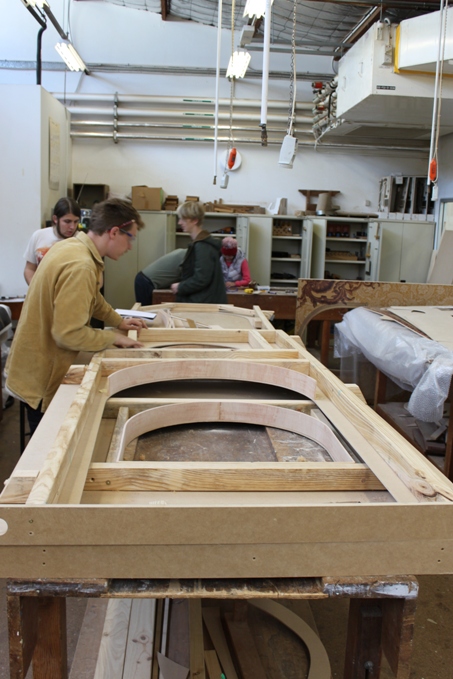
Princely Treasures installation is madly underway. Students from Curtin University have kindly donated their time to design, build and install a Princely Palace for all the little ones to explore right next to the exhibition. This space is free for kids to enjoy, so parents if you’re looking for an angle to convince the kids to come to the exhibition, here it is. This space is open for the entirety of the exhibition but you don’t have to visit the exhibition to enjoy it, come as often as you like. Also as a little bonus, and thanks to the Friends of the Gallery we have a friendly helper facilitating art activities for the mini princes and princesses to enjoy throughout the holidays and over the weekends.

Here’s a little peek into the installation of the Palace as it comes to life…


Friday, 9 September 2011

True vs False


As one may suspect, the truth is often the subsidiary factor or unnecessary detail that turns an amazing tale into something aligned with a school history paper. I love a good story and I love a good false fact. I say who needs the truth all the time; let’s enjoy some fabrications that make history all the more enjoyable…

Kelly (our intern) has intuitively taken the time and researched many of the rumours surrounding the vast facets of courtly life. Our intention here is not to spoil any of the “truths” surrounding these apparent myths but rather to enlighten our avid followers. These are our facts, which may or may not be accurate…. everything is debatable, which I think makes fact claiming all the more enjoyable.

And ps… we’ve included web links under each claim which ultimately prove our “truths” to be undoubtedly factual… or so I like to tell myself. Enjoy!   

Jeanne-Antoinette Poisson, Marquise de Pompadour
(1721– 64)
France, 1758
Oil on Canvas
V&A: 487-1882
©Victoria and Albert Museum / V&A Images


Myth: the breasts of the beautiful Madame Pompadour were used as a model for champagne glasses.  


FALSE


This rumour has been associated with many different famed beauties of the European courts, including Madam Pompadour and Marie Antoinette. In fact, the champagne glass was designed and created in England around 1663, long before these women were even born. (http://www.snopes.com/business/origins/champagne.asp)


Myth: Charles II of Sweden is responsible for starting the longstanding tradition of giving flowers as a gift.

TRUE

Charles II of Sweden introduced the practice of floriography to his court in 1714. The idea was, all flowers had individual meanings, and a bouquet of flowers could convey a secret message to the receiver. The trend spread across the European courts, and the custom of giving flowers has survived today. (http://www.thewitchesalmanac.com/floriography.pdf)


Myth: Marie Antoinette, upon hearing that the French peasants were suffering a bread famine, was famously quoted as saying “let them eat cake.”

FALSE

Although this phrase is often attached to the indulgent French Queen, Marie Antoinette cannot be quoted for the line “let them eat cake”. The phrase has been attributed to Jean-Jacques Rousseau, a philosopher and writer who included the phrase in his work ‘confessions’, which were written when Antoinette was only nine years old. (http://europeanhistory.about.com/od/antoinettemarie/a/histmyths4.htm)


Myth: Hairstyles and wigs became so grandiose, the by the 18th century wigs stood over one meter tall.
FALSE

Hairstyles became more elaborate over the course of the 18th century, but hair and wigs over a meter tall only appeared in satire. It is believed that hairstyles that tall never came into vogue. Other rumors about women not washing for weeks to preserve their hair, or finding vermin nested in their wigs, are believed to be false as well.


Myth: objects were woven into a Lady’s hair, and at one stage there was a fad for large model ships used to be used as a hairpiece.
 

TRUE


As unbelievable as it sounds, there was a brief fad ignited by the victory of the French Frigate La Belle Poule against the English in the American war of independence. To celebrate their victory, French courtiers would fix a model ship into their hair, the layers of hair acting as the sails for the ship. The fad, although famous, is believed to have only lasted for a few weeks, before the fashionable Parisian courts moved onto more outrageous things. (http://xenophongroup.com/mcjoynt/poule.htm)


Myth: Catherine II the Great of Russia died in 1796, when the toilet she was sitting on collapsed under her.

FALSE

Although Catherine the Great did not die on the toilet, she did have a stroke in her bathroom that proved to be fatal. In fact, Catherine died a few days later, and not in her bathroom. (http://europeanhistory.about.com/od/catherinethegreat/a/histmyths1.htm)


Tuesday, 30 August 2011

Introduction and a bit about the Victoria and Albert Museum

The tension is palpable and excitement looms in the distance; it’s just three weeks until the Gallery’s second instalment of the Great Collections of the World series. Calm and collected is certainly not an apt description of the atmosphere in the administration building, but would you expect anything less? Perfection is the key and no one here would have it any other way. Perth has, once again, been given the opportunity to prove itself as a city worthy of prestigious exhibitions, exhibitions not shown anywhere else in the country.

Now, I know I may sound a little biased, and yes, I do have a vested interest in this exhibition and in the Gallery itself, but I hope my affection for both will translate in this blog and perhaps some of you will find my ramblings insightful or enlightening? Or not? Feedback and comments are always welcome, and if there are any topics of interest you’d like to learn more about, tell me and I’ll set my eager little interns on the case.

Just a snapshot of how I came to be the author of the Princely Treasures blog. My journey began about a year and half ago as one of these elusive “eager little interns”. Having always dreamt of working at the Gallery, I felt as though my seven years of study and a $26,000 HECS debt had finally served its purpose. And that it has, working here, in the marketing department, I love my job, I love my team and wouldn’t change a thing!

Ok, enough gloating… I thought I’d kick things off with the obvious, the Victoria and Albert Museum, London. Since I’m sure many of you have already perused our newly launched and undoubtedly informative Princely Treasures website, I thought it more appropriate to tell you some interesting facts that you may not already know…

  • It’s original name was the Museum of Manufacturers
  • Queen Victoria really wanted to call the V&A the 'Albert Museum'.
  • The first Director, Sir Henry Cole, described the Museum in 1857 as 'a refuge for destitute collections'. More than a century later Sir Roy Strong called it 'an extremely capacious handbag'.
  • 2.37 million people visited the V&A at South Kensington in 2006, the highest figure ever.
  • The worst scandal in the V&A's history occurred in the 1950s when a member of staff was found to have stolen several hundred objects, including a number of swords which he smuggled out of the Museum down his trouser legs.
    (
    http://www.vam.ac.uk/content/articles/v/v-and-a-150th-anniversary/)

The name alone, Victoria and Albert Museum, has the ability to recall an allure of decadence, monarchist significance, which draws our attention to a world seemingly beyond the grasp of many of us mere mortals. This said, the ideals of this far removed period, 1600 – 1800, highlighted by the Princely Treasure exhibition, are also filled with scandal, treachery and all things seductive. The hidden escapades of the royals and elitists aristocrats make for some interesting readings.

I know, for me, many of the items I’ll see in the flesh will only accentuate my desire to find a porcelain tea-set hidden at the back of an old wardrobe. Then I too, can impress and shock one of those fancy historians on Antiques Road Show. Alas, I can only dream. I know I will still find grand enjoyment in the simple pleasure of being surrounded by such precious, intricate and beautiful things, things that contain a rich sense of history and represent a period of time so foreign to the world I live in today.

Till next time... Renae